Will Robinson and Zeus
It was with much excitement that I entered the jester Baltimore Challenge this year having been unable to in 2023 due to work and a family emergency.
I had bought Zeus an Achilles 24 a few years ago, and had been looking for an excuse to sail it offshore and test its seaworthiness and seakindliness, and my endurance, so the Baltimore Challenge was the perfect opportunity. She represents to me a perfect Jester challenger, small, simple, fun to sail, and well built.
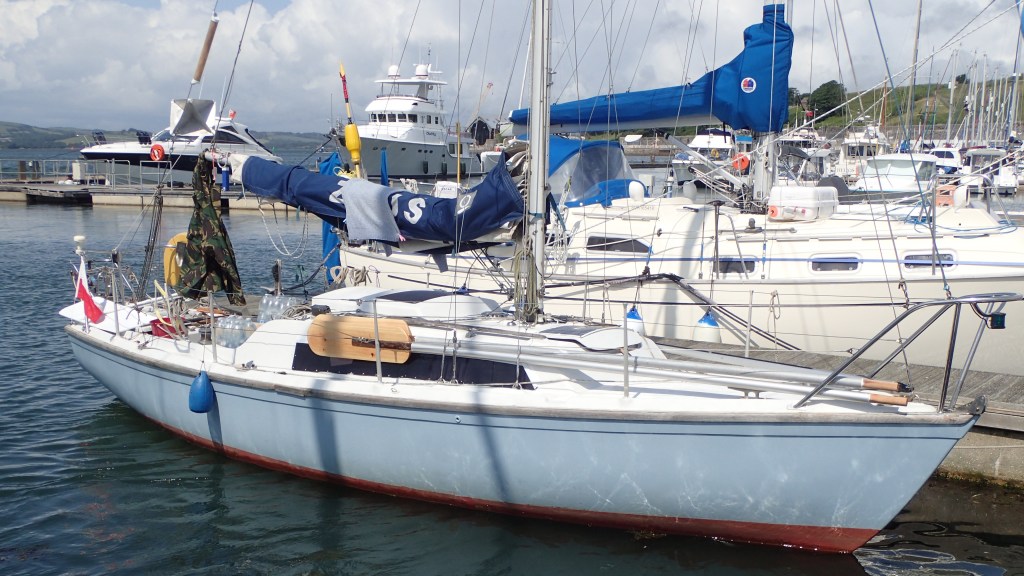
Having cruised a lot and met many salty sea dogs, I have come to the conclusion that any boat can sink, and there is more security in a minimalist mentality than investing every penny into a vessel. Sailing offshore will always have risks, at some point anyone may have to abandon their boat, and comprehensive insurance is generally problematic in many areas of the globe. Therefore the go simple, go now adage is still one of the most powerful. I have also found the smaller the boat generally the more fun it is to sail, the more responsive it is, and easier to fix, but also easier to learn and listen to. A small boat will tell you when it’s not happy far sooner than a big boat, and there is then less need for expensive electronics, and more opportunity to develop a ‘feel’ and intuition for the boat and elements.
I left Cowes the day before round the island race, having told my usual ride I wasn’t available, and not wanting to be Shanghaied! so the first test was getting out of the Solent. I only made it as far as Newtown creek when the tide turned and progress halted, so I anchored off, stowed away my outboard engine and waited for the tide to turn.
Sailing upwind into 20-25 kts didn’t make for an easy delivery to the start, so it was a small hop to Studland and another nice anchorage to visit. The following day the wind was supposed to veer therefore supposing I got sufficiently far offshore I should make it all the way to Plymouth with an improved tacking angle. It all went according to plan; I got headed at just the right time and had a reasonable passage, which was remarkably dry and comfortable considering the conditions. It’s a myth that small boats are wet and uncomfortable. However I have taken to wearing a dry suit, not just on my boat but also when racing offshore. It is not just the fact that I can be totally dry and comfortable, and not hesitate to go forward to change a sail for example, but also provides a lot of security in case of falling overboard; it’s almost as if I am wearing a life raft combined with an ais and epirb plb.
Again the tide turned this time as I was just off Salcombe so that was where I ended up. I sailed in and dropped anchor just inside the harbour, it was a truly impressive backdrop, paradisical with sheer cliffs and a sparkling beach. The following day I made it to Plymouth and luckily without too much to fix before the start. I was very impressed with Mayflower marina, although. I would have preferred the Jester fleet to be allocated berths in the same area.
It was a fine afternoon for the start with a reasonable breeze and typical south westerly wind.
At the start line I was particularly enthusiastic and hoped I wasn’t over because I wasn’t sure of the Jester etiquette for this, I decided I was on the line and wasn’t going back, so I had a great start and was one of the first few boats at Draystone ledge buoy.
Anticipating the wind to back I tacked along the coast towards Falmouth getting west as quickly as possible to round the lizard with fair tide.
After the lizard the wind started to drop and became very shifty, it was hard conditions for the windvane steering which kept tacking the boat or reaching off, so I ended up hand steering for much of the night, and trying to figure out how to get it to keep on course with various bits of bungee. I decided to use what little wind there was to get inshore in case of needing to anchor, I started drifting backwards briefly but managed to keep sailing and when the tide turned was in a good position having overtaken the boats further south. Having said that, I think the Hasler vane fairs better than almost any other windvane in light breeze, for a start the vane is 3-4 times the size, and rotates smoothly rather than flopping from side to side.
The wind shifted (the wrong way) and it was upwind all the way to Bishop Rock and the Scillies but I managed to keep sailing and avoid the TSS shipping lanes, which was my biggest worry.
I could hear the wolves (seals) off Wolf Rock as I passed very close, with a perfect timing just as the tide turned northwards. I had realized that it was worth the hard work the previous night to get ahead six hours, and further through the middle of the high pressure.
The sail northeast was fairly uneventful, with a light breeze and patches of no wind. Having lost java blue on the ais I kept seeing these 7m boats overtaking me, and wondering who they were and who gave them the right to overtake, so I put up a reasonable fight for the double handed mini transats, even keeping up with some of them in the light and shifty conditions, but about 2 knots slower when the breeze filled back in. It certainly makes it a lot more interesting when there are lots of other boats around.
At one point I changed jibs to what I thought was a number 1, but it was actually a number four, then I tried rowing, but my oars were too long. I even tried rigging a flying jib poled out on one of my sweeps in front of the forestay, it worked well but was in danger of breaking something. Finally when the boat speed was zero I had the storm jib up, which flapped about less, and got the boat moving again
Two hitchhikers showed up, both racing pigeons, the one that arrived first came into the cabin, but I quickly realised this was a bad idea, as they were not toilet trained, so I cast them out to the poop deck, and eventually I had them sitting on the tiller with a bucket below catching their droppings. When I rinsed the deck with water they tried to drink it; they were very thirsty so I gave them some water. I read later that they can be fed dried rice, so will do that next time.
I was waiting for the forecast to play out, but it never did. There was a huge discrepancy in the forecast and looking at my barometer and the local wind conditions I realised I was still in the high pressure and tacked out to the west to get through it. I realized the wind was going to fill in from the opposite direction; it was an easterly wind filling in from the west, so I also didn’t want to go too far west! Eventually I found the breeze, and gradually got lifted up, to the point I could fly the Spinnaker.
So there I was with the Spinnaker up, it was fast now! I had the log reading 8 knots at one moment, pole forward to avoid the TSS, a few mini transats about to race. It was about now the self steering stopped working, every time I tried to change the course the worm gear popped out, but I was enjoying the sail too much so I held the Spinnaker all the way to the Fastnet.

At the rock was interesting, the fleet of mini transats rounding to port, and a few crazy Englishman (and women) to starboard. It was a bit of a standoff and I ended up inside the mini transat that was also rounding. then it was a quick struggle to put reefs in and change jibs for the beat upwind to Baltimore.
After a few minutes I couldn’t find my pigeons and I was worried they went inside the cabin with the spinnaker and jibs, no, hopefully they made it.
It was a stiff wind off Ireland, about 25 knots, but with the number four jib up and three reefs Zeus was sailing well.
I ended up sailing right into the harbour and onto a mooring, which was fortunate as the following day I got my outboard out and had to change the spark plug before it would run.
Thanks again to the Jester helms for organising such a great event, and well done to everyone who made it to the start line this year.
 Jester Challenge