George Arnison and Good Report
My passage to Baltimore was dominated by slow, upwind sailing interspersed by periods of (even slower) windlessness and becalment. It took me almost 5 days, and I think I might have been the last to arrive…but arrive I (eventually) did – happy and pleased, without any disasters or major dramas.
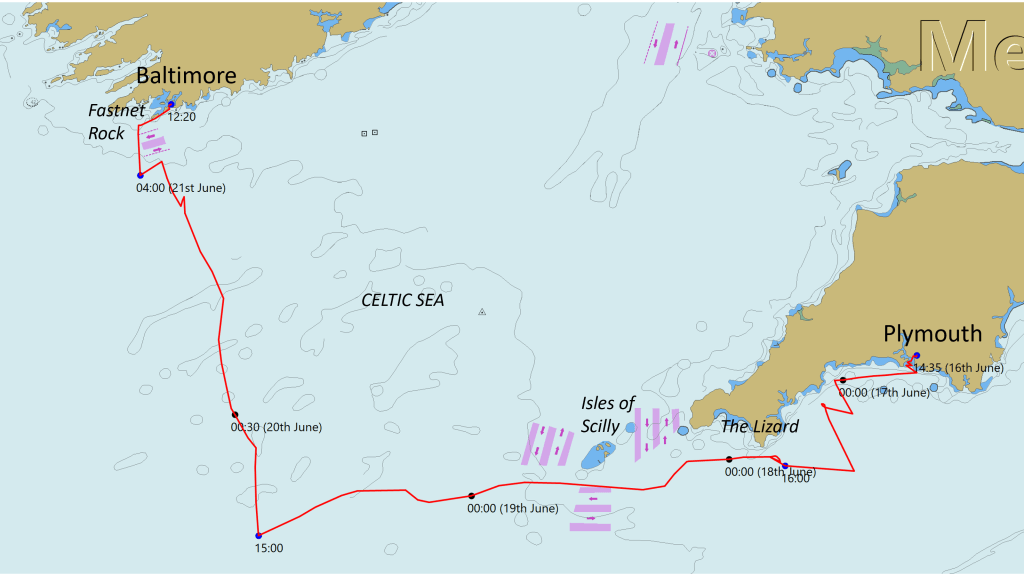
With the SSW wind coming almost exactly from the direction I wanted to go, just getting out of Plymouth Sound was difficult and my first 24 hours involved long tacks in which I had to sail twice the distance I actually wanted to travel.
The initial 12 hours or so were particularly uncomfortable as we beat into a strong Force 5-6 wind and a large, lumpy sea (a legacy of strong winds over the preceding few days). The waves constantly stopped Good Report’s forward motion and we seemed to spend as much time going up and down, as forwards.
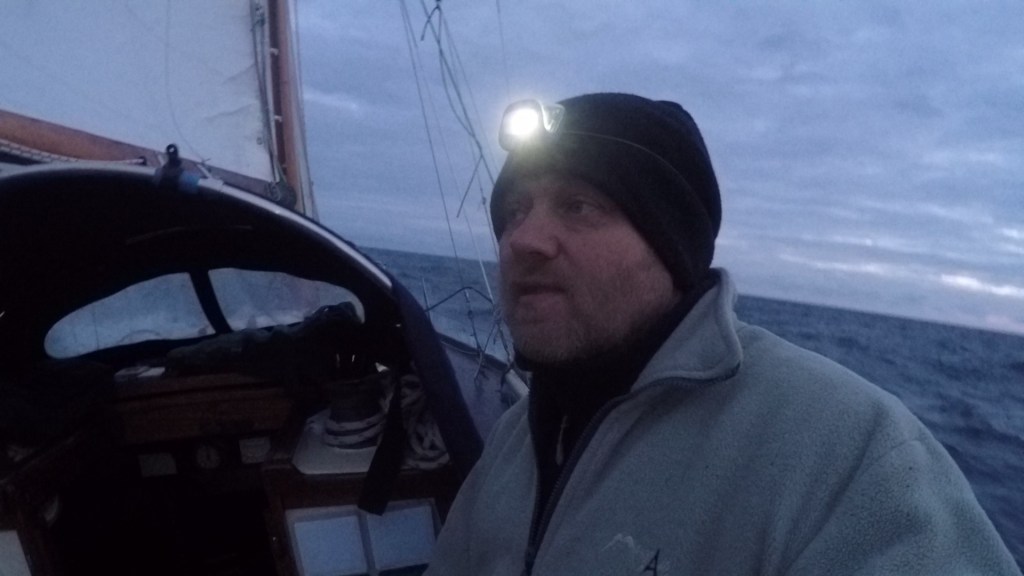
I felt seasick from the start…and for the first time I can remember was actually eventually sick in the middle of the night, after which I started to feel better. Nevertheless, I didn’t eat or drink anything other than water for 24 hours, and given the angle and motion of the boat did very little other than keep watch, periodically tack, read and catnap.
By around 4am the wind began to reduce (to F4), and the sea to moderate (to moderate) and by Monday 4pm as I approached the Lizard, it had dropped to around F2.
The following extracts from my log summarise things fairly well:
- 17:00 “Struggling to get out of Plymouth Sound. 2 Reefs in Main. 1 in Genoa. Tacking.”
- 18:00 “Sorted pulled through genoa sheet. Stbd genoa winch seized. Using Port winch for both tacks”
- 19:00 “Shook out 2nd reef in Main. Big effort. Big difference. Doubled speed but much bumpier”
- 20:00 “Feeling seasick & cold. Not eaten since breakfast but don’t feel like it.”
- 01:00 “Sick. Feel better for it”
- 04:00 “Domestic battery not holding charge. Running engine to charge batteries”
- 12:40 “Engine off. All electrics switched off – except AIS”
- 16:00 “24 hour point. First food: Lunch = a challenge!”
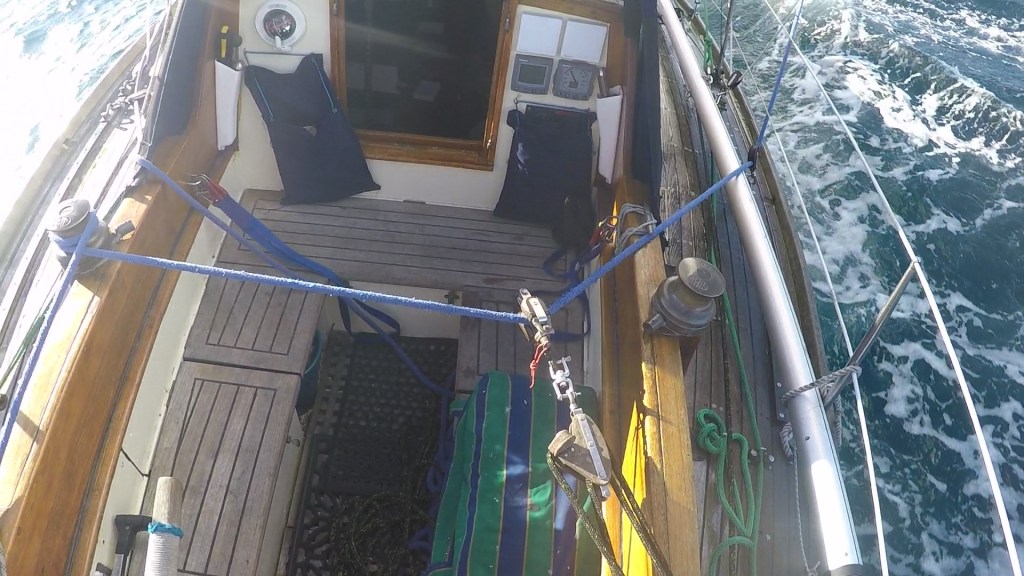
A number of technical problems materialised fairly quickly – which plagued me for the rest of the trip. The first of these was that my starboard genoa winch was completely seized (to the extent that I couldn’t even strip it down), and of no use at all other than as a bollard.
I rigged up a block and tackle to transfer the Starboard genoa sheet to the Port winch, and thereafter just used the one winch for both tacks. This worked reasonably well, though did ‘cut the cockpit in half’ when we were on port tack.
As the wind dropped during the first day, I also found that my service battery was not holding its charge. As a result I literally ran out of domestic power (for chartplotter, VHF, AIS, internal lights, external lights, ipad/phone charging etc). Below about F5 the wind generator just didn’t generate enough amps to charge up the battery which drained down suddenly and quickly.
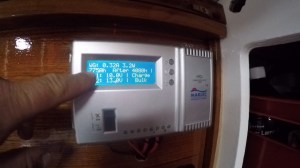
My management tactic was therefore to periodically run the engine for 45 minutes to charge the battery up (when I would also plug everything in and turn everything ‘on’) and then in between engine charges to turn everything ‘off’ to conserve power. The only exceptions being my AIS (key safety device and consumer of minimal current) and at night my masthead tricolor nav light. I relied on my hurricane oil lamp for internal lighting (bright enough to see but not quite enough to read by) and monitored battery levels closely to determine when I next needed to start the engine.
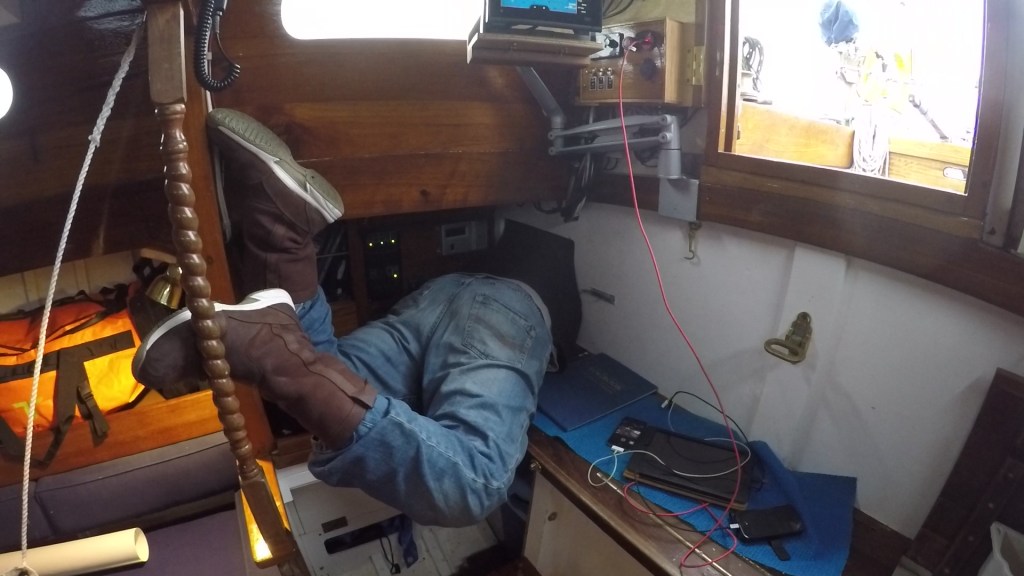
Over the course of the trip I ran the engine for about 18 hours just for battery charging. I hadn’t anticipated using the engine at all really so had departed with only half full fuel tanks and was a little concerned as to how long this would last. So I also had to periodically crawl into the aft quarter spaces where the fuel tanks are to check fuel levels with a torch.
The Lizard is an iconic headland – the most southerly point of the UK mainland – and it is important to round it with the tide. Thanks to the wind dying away as we approached….we just failed to do so, and then got becalmed on the wrong side !
- 18:00 “Tack. Basically standing still. Limited forward progress cancelled out by tide against us”
- 21:00 “Pretty much back where we were at 17:30”.
Very frustrating…the only plus side being the fact that the sea state continued to improve and by 23:00 when the next ebb tide had eventually carried us around the Lizard, I could record the sea as “calm”.
By the early hours of the morning, the wind had died away completely and we just drifted with the tidal currents…luckily in roughly the right direction – towards the Scillies. A gentle Force 2 breeze gradually came back around breakfast time and – as forecast – backed to the East. For a precious few hours, we had the wind behind us (!). I got the Spinnaker up and just enjoyed the fine conditions.
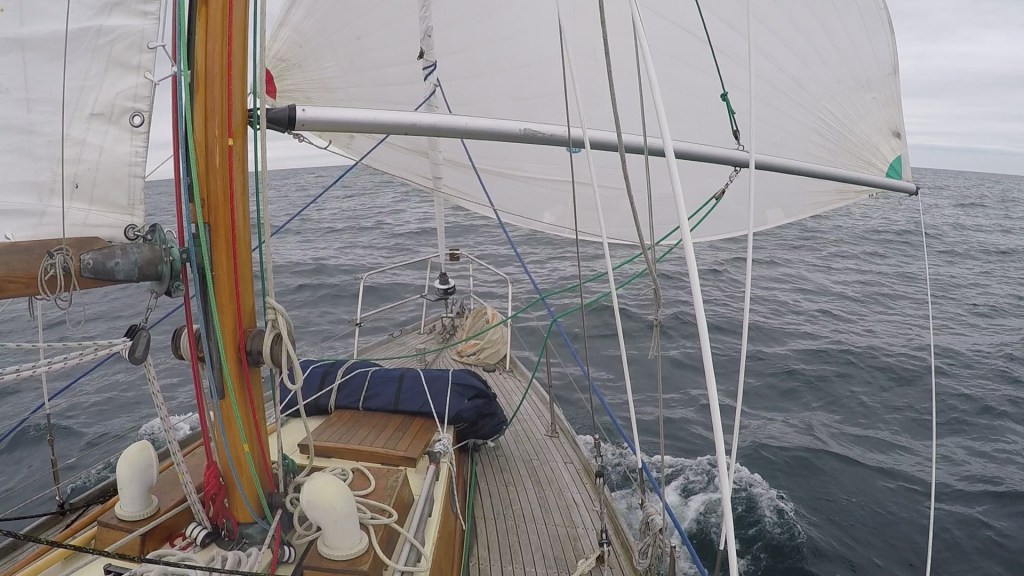
The wind continued to back, so by 16:00 I had to drop the Spinnaker, but we continued to make gentle progress westwards below the Isles of Scilly on a beam reach with a Force 3-4 Northerly wind.
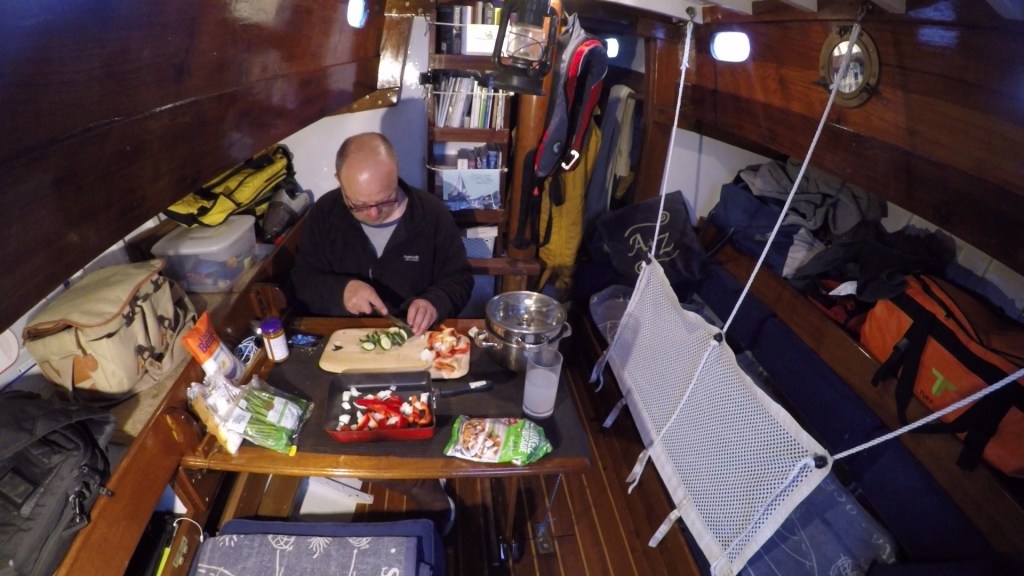
I took the opportunity of the benign conditions to do some jobs on board, and to cook a proper “two pan” dinner (curry and rice) – the only time I did either on the whole passage. It is amazing what a difference it makes to everything when the boat is reasonably horizontal and not bouncing around.
- “22:00 West of Scillies heading out into Atlantic. Empty sea. At peace”
The wind continued to back through North, to NNW to NW and strengthen back up to Force 4-5. This was all reasonably in accordance with the forecast that I’d recorded before leaving Plymouth…which predicted that it would end up blowing from the West…and staying that way for a couple of days. My tactic was therefore to sail westwards for as long as possible, until eventually the wind direction would make further progress in that direction impossible and I would have to tack to the North. I hoped at that point to be due south of Baltimore, and have a nice beam reach to our destination.
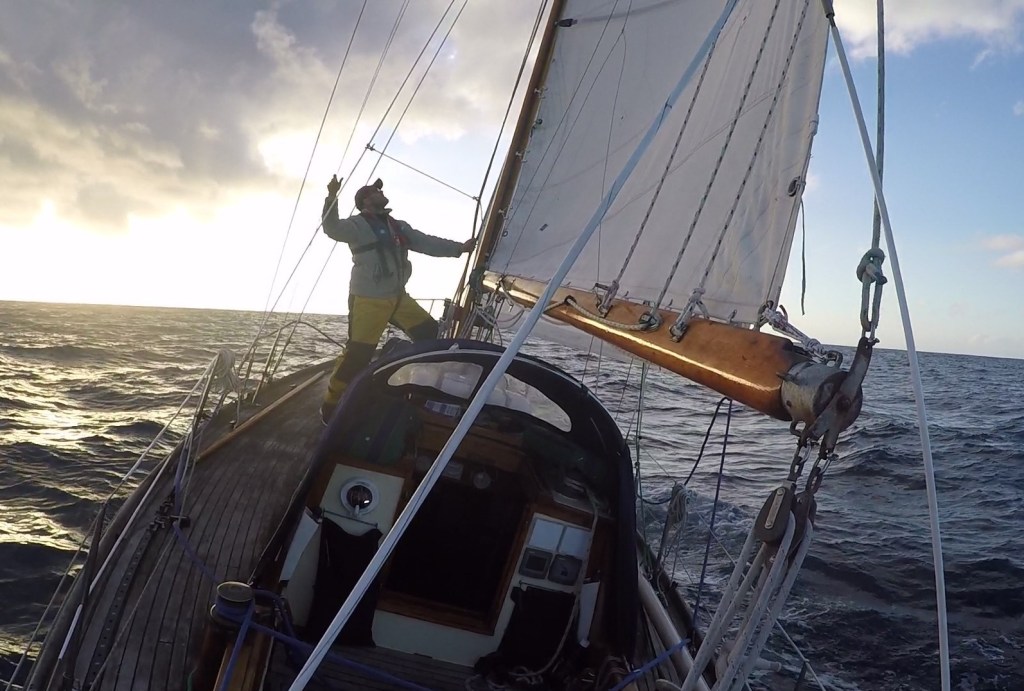
I managed to sail (or drift) westwards for almost 48 hours. During that time, the wind steadily backed from the South (very light, mostly drifting), through East (F2-3, running with Spinnaker), through North (F3-4, comfortable beam reach) to WNW (F4-5, close hauled).
By 15:00 on Wednesday – just after we had crossed into Irish waters (which I marked by raising my Irish courtesy flag) – with the wind pushing us increasingly south I deemed it time to ‘turn right’.
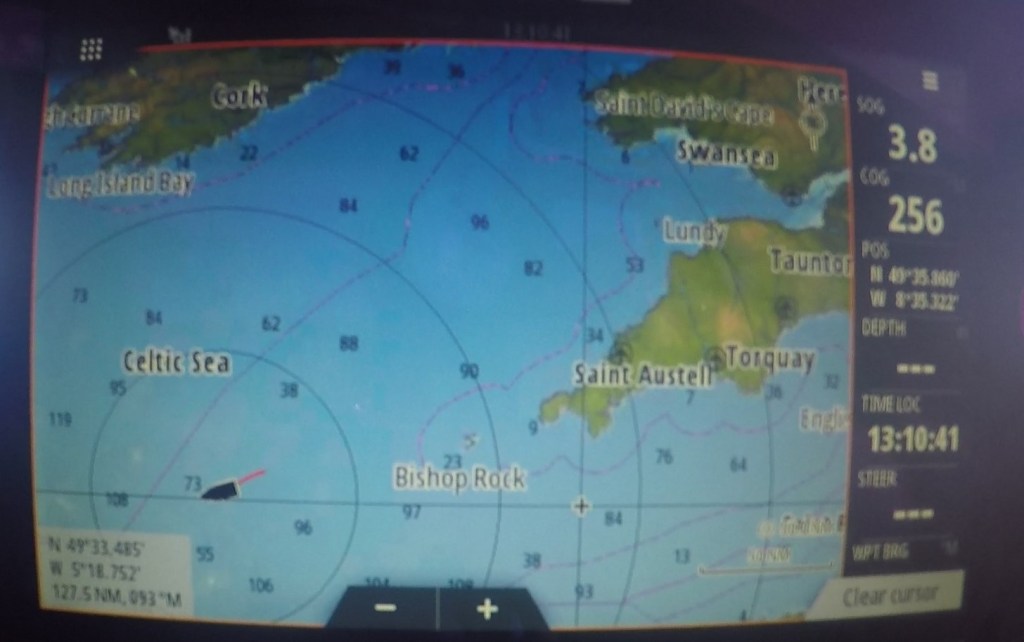
We tacked North about 50NM earlier than I’d have liked really. As a result instead of having a nice beam reach up to Baltimore, we found once again close hauled and beating into the wind, still having to make progress to the west as well as north, in order to clear the Fastnet Rock 100NM away.
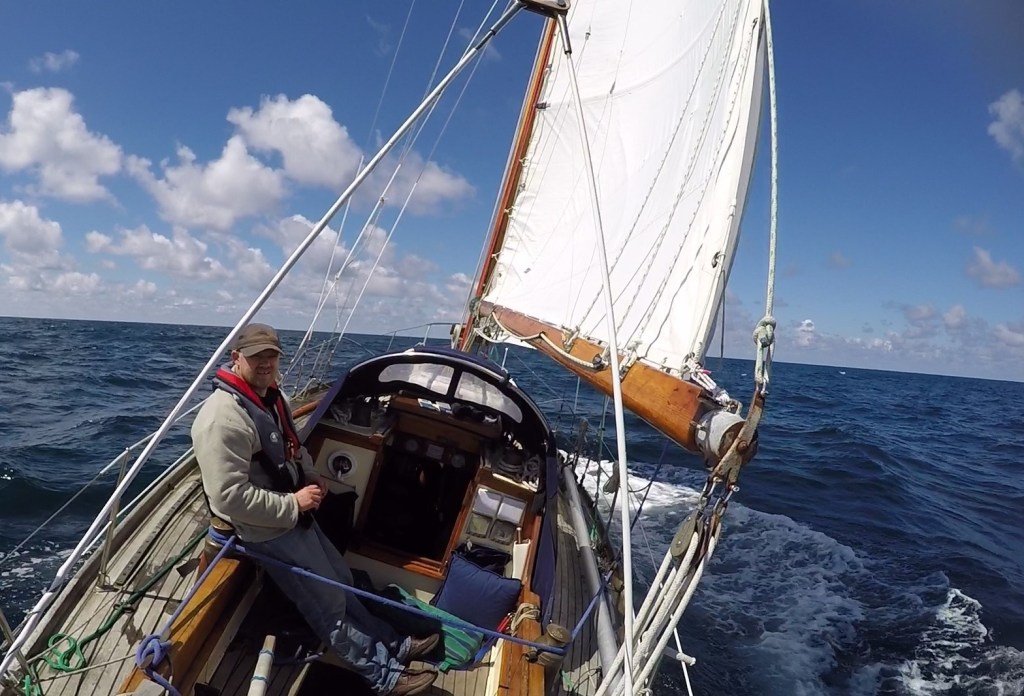
The wind strengthened to Westerly Force 5 and the seas built up again, and our motion again became very uncomfortable…and slow.
At dusk I could see a nasty looking squall on the horizon and put a precautionary reef in both the main and genoa before it got dark. I was glad I had as the wind strengthened markedly (to Force 6+) and the seas got suddenly much rougher, with big waves rising above the cockpit coaming in the dark. The atmosphere was made quite spooky with a large, pink coloured moon – which must have signified something, though I don’t know what.
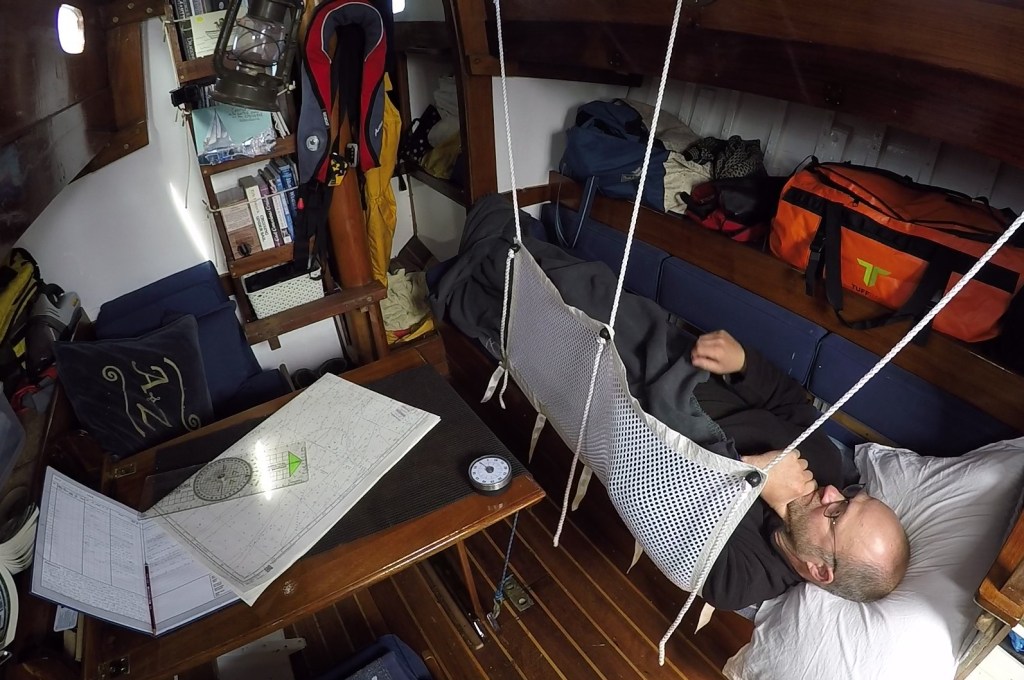
I literally ‘battened down the hatches’, putting in the companionway washboards and closing the hatchway, and wedging myself in my bunk where I only remained thanks to the lee cloth. As well as the bumpy motion, it was incredibly noisy below, with a symphony of thumps, bangs, crashes and rattles. I found it very difficult to actually locate any of the sources of noise, which invariably disappeared as soon as I poked my head outside to investigate.
- 01:00 “Conditions worsening. Bumpy & Noisy. Put 2nd reef in both main and genoa. Feels better. Big black cloud coming !”.
The combination of darkness and the big waves meant that visibility was very limited…and I probably wouldn’t see another vessel unless it was very, very close. Luckily, I was in the middle of a very empty Celtic Sea and hadn’t seen another vessel for over 24 hours, so I wasn’t concerned about maintaining only a rather tokenistic watch.
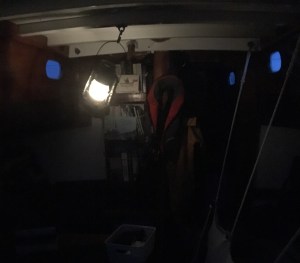
It was all very atmospheric, enhanced by the fact that my only internal light came from my trusty hurricane oil lamp swinging violently from the cabin ceiling. Concern would be too strong a word, but I did have a momentary pause for thought about the exposure of being inside a little wooden box, in a dark and rough sea, 100 miles from land….
The rough weather continued through the night, but conditions moderated in the morning and by 11am it had reduced to Westerly Force 4, I had shaken out all the reefs and our motion had improved to the extent I could actually sit at the cabin table and catch up on some navigation.
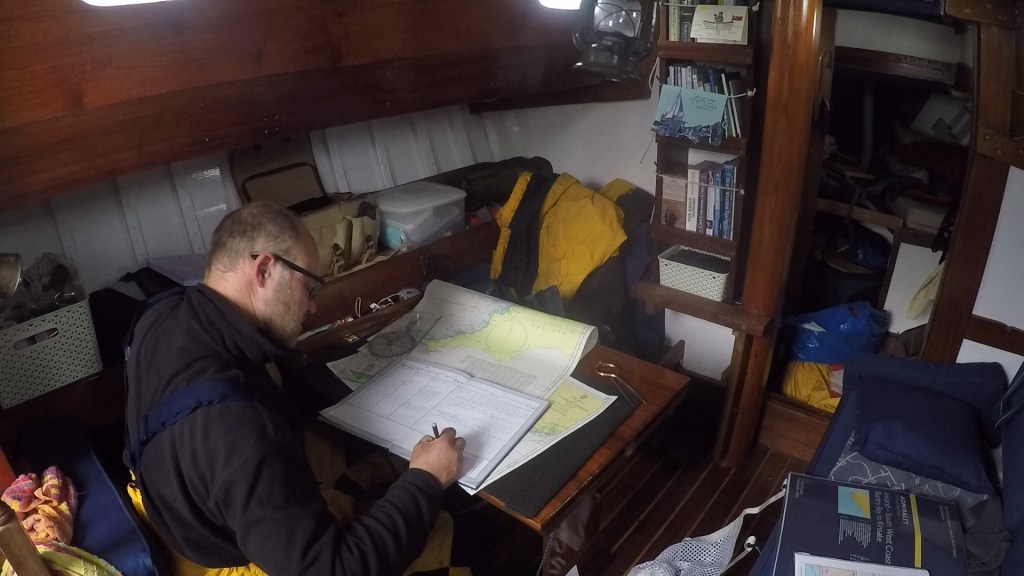
The wind continued to be broadly from the west for the rest of Thursday, but fluctuated a lot and at times was quite flukey, making it difficult to maintain direction and at times I was almost stationary.
- “18:45 Need to get to the west of the Fastnet Traffic Separation Scheme. Speed less important than direction.”.
However despite sailing as close to the wind as possible, I just couldn’t get west enough so just before midnight as I approached the TSS I tacked and sailed SW away from it until 4am when I felt I was sufficiently clear to tack north again.
Friday 04:00 to 12:20 (8 hours 20 mins, 25NM, av SOG 3.0 knots)
Shortly afterwards – and very suddenly – the wind died completely, to absolute zero. Not a breath. Nada. For about 3 hours we just drifted…very slowly… in the vague direction of the Fastnet Rock about 3 NM to the north of us. The sea was completely flat, and Ireland welcomed us with a particularly beautiful sunrise.
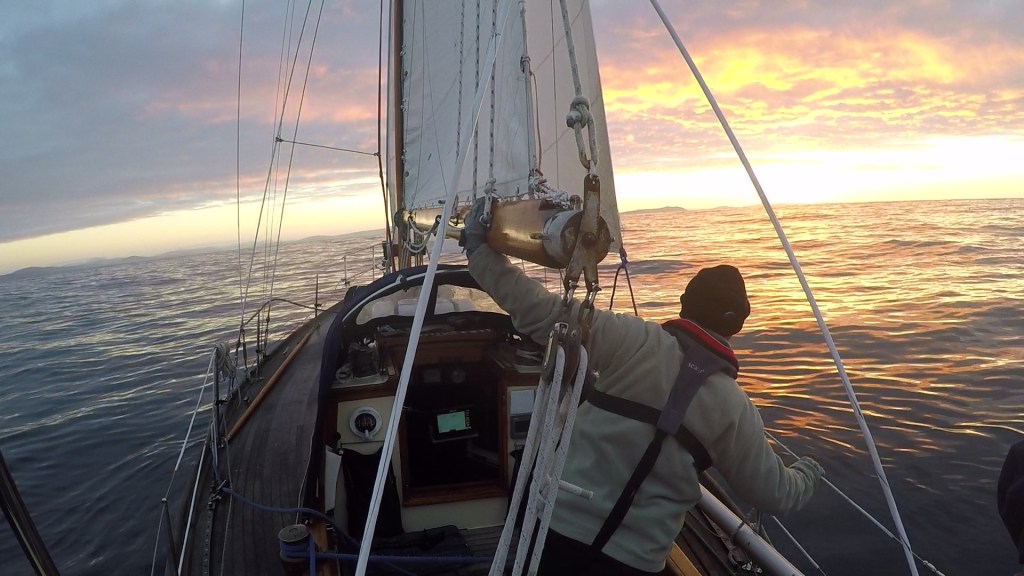
At 6am I also had surprise phone call from Pa wondering where I was…and in which he confirmed that the lack of wind was exactly what the weather forecast was showing. I tried sculling the rudder to get a bit of forward motion, and even contemplated pumping up and rowing the dinghy to try and tow Good Report. Eventually – and after a bit of soul-searching – I decided that it would be rather embarrassing if we just drifted into the Fastnet Rock, and that the seaman-like thing to do would be to actually turn the engine on. So I did… and we motored for 45 minutes around the Rock, going much closer to it than I expect is normally possible/advisable. It really is a VERY impressive feature.
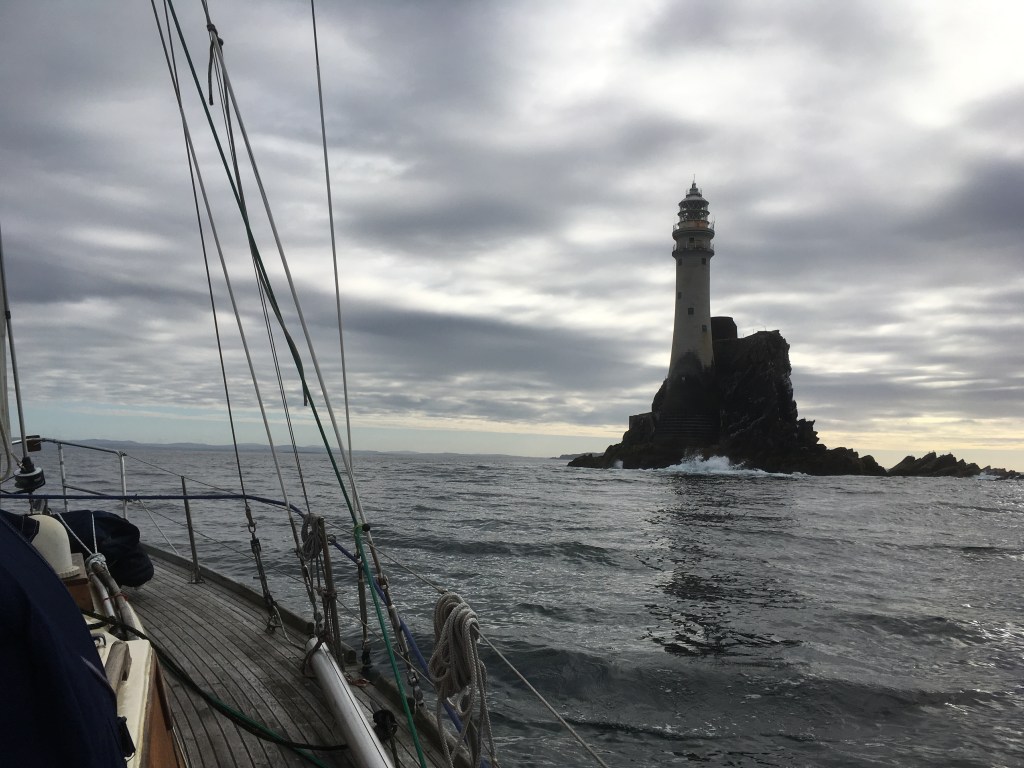
Once round and clear of the Rock, I switched the engine off and we picked up enough of an onshore breeze to slowly sail the last 10 miles to Baltimore….crossing the official finish line (Loo Bouy) at 11:50 with a sense of quiet satisfaction, if not a fanfare of trumpets !
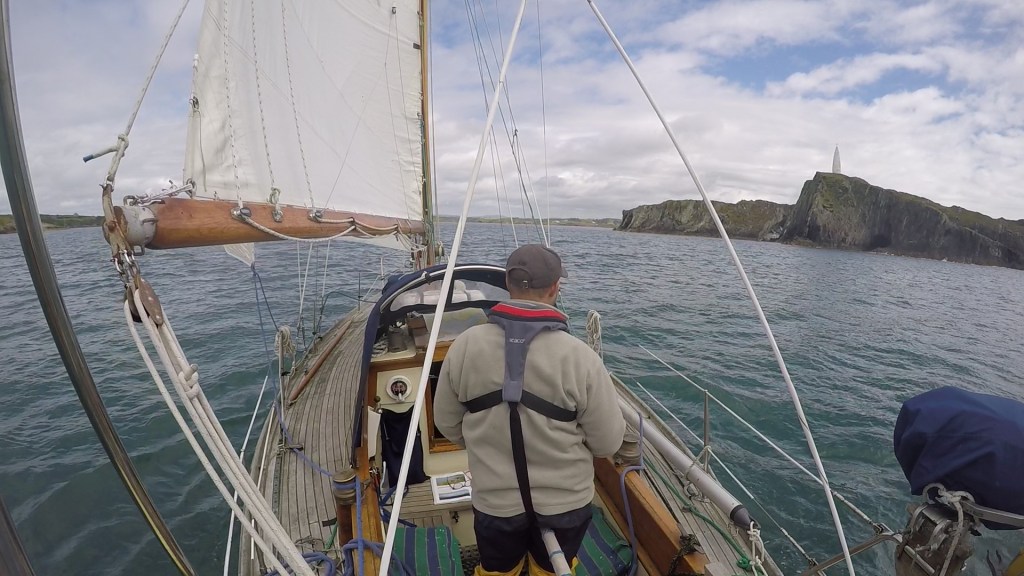
I anchored in the harbour amongst a dozen other Jester boats (identifiable from our Jester burgees – very useful), and after a little while sorting myself out went ashore to investigate.
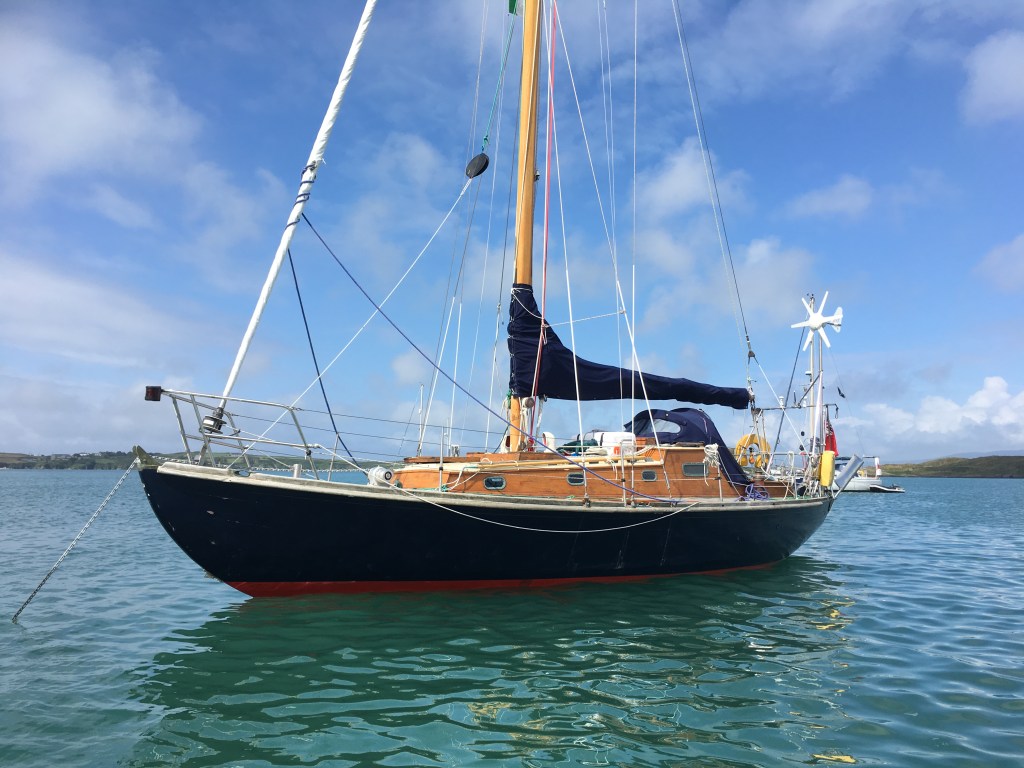
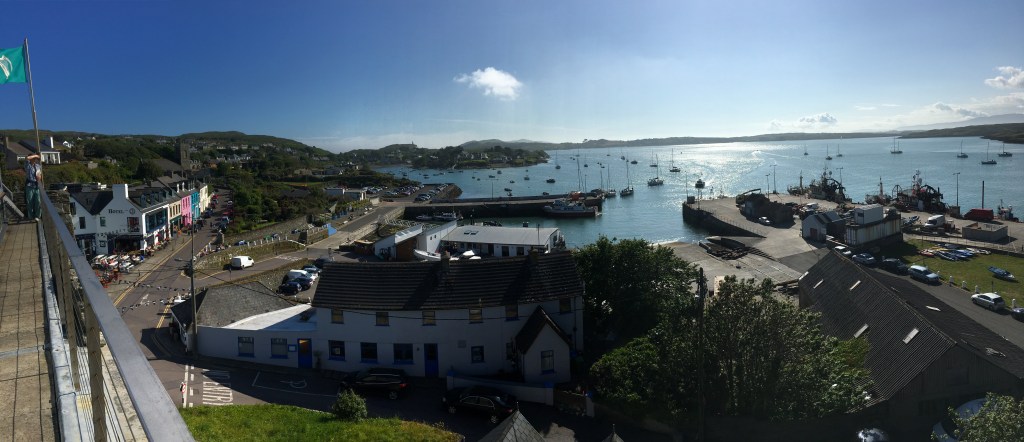
The centre of Baltimore is an attractive 50 m frontage over-looking the harbour, which has an uninterrupted line of half a dozen pubs/restaurants…and a grocery shop. Lots of people were sat out in the sunshine eating and drinking, and (probably still benefitting from a slightly sleep deprived state of euphoria) I very boldly walked up to the first table which contained a bunch of weather-beaten faces, and said “Hello, are you Jesters ….?” Luckily it turned out they were!
Single-handed sailing is – obviously and by definition – rather a lonely business, and of course I could have sailed to Ireland by myself any time. However, by taking part in the Jester Challenge, you instantly become part of a group, a family even. Welcomes are instant and chat effortless, as everyone is in the same situation, and have been through similar experiences. So meeting and socialising with other Jesters over the following few days was one of the best parts of the whole experience.
The end of our Challenge coincided (by design) with the annual Baltimore Pirate Festival – which celebrates (?) the sacking of the village by Barberry pirates in 1631 – when pretty much the whole village was kidnapped and borne away for a life of slavery in North Africa. (I read a very good and eye-opening book about it en passage). So on the Friday night we all attended the official – and quite excellent – Pirate Dinner at the Baltimore Sailing Club. At least a token effort at pirate fancy dress was expected.

We then retired to the ‘Algiers pub’ and divided into teams for a fairly raucous pub quiz. At this point – and bearing in mind I hadn’t really slept for 36 hours – I completely lost my voice !
Over the next few days, as some participants headed home, others of us remained in Baltimore and continued to meet up onshore and visit each others boats. It was a real pleasure to make friends with like minded souls, compare notes and see some of their boats. Not everyone had made it to Baltimore, with a few retirements along the way, but everyone was accounted for and overall it seems to have been regarded as a success.
One topic of discussion kept coming up over medicinal pints of the black stuff:
“So, what are your thoughts on doing the Azores next year ?
Definitely thinking about it…
…Me too.”
Passage Summary (Pontoon to anchor):
- Total distance logged = 400.1 NM
- Duration = 4 days 21 hours 45 minutes
- Average SOG = 3.4 knots
- Winds: Force 0 to Force 6 – from all directions.
- Close Hauled – 82hrs (70%); Becalmed – 14 hrs (12%); Beam/Broad reach -14 hrs (12%); Running – 4 hrs (3%) ; Engine – 3.75 hrs (3%)
With thanks to George Arnison for allowing us to publish this extract from his personal blog.
 Jester Challenge